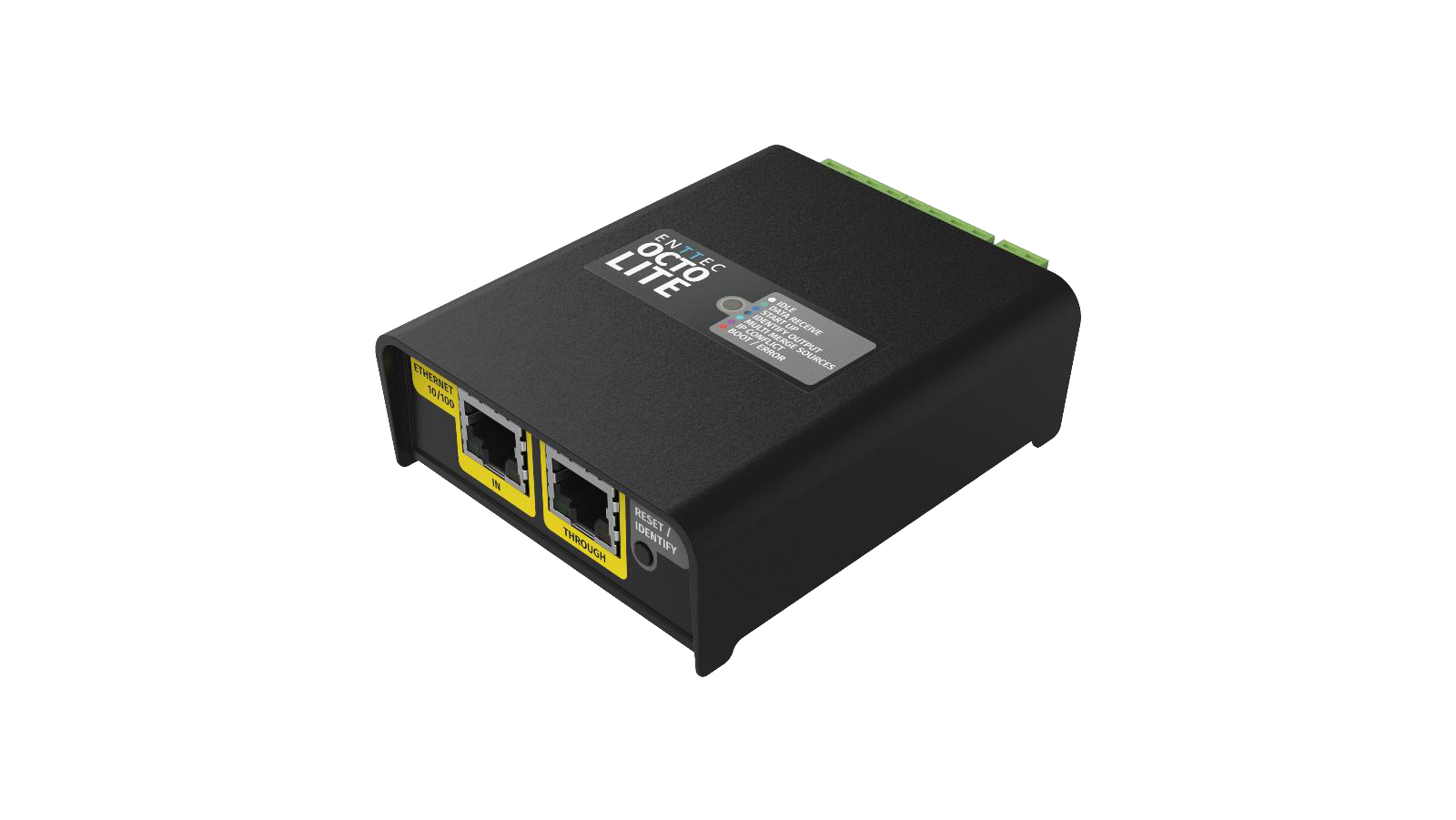
eDMX to SPI pixel controller converting up to 8 universes of SPI data in a compact 4-module DIN-rail form factor.
⚠️ Safety
Ensure you are familiarised with all key information within this guide and other relevant ENTTEC documentation before specifying, installing, or operating an ENTTEC device. If you are in any doubt about system safety, or you plan to install an ENTTEC device in a configuration that is not covered within this guide, contact ENTTEC or your ENTTEC supplier for assistance.
⚠️ Heads up: ENTTEC's return-to-base warranty for this product does not cover damage caused by inappropriate use, application, or modification to the product.
⚡ Electrical safety
- This product must be installed by applicable national and local electrical and construction codes by a person familiar with the construction and operation of the product and the hazards involved. Failure to comply with the following installation instructions may result in death or serious injury.
- Do not exceed the ratings and limitations defined in the product datasheet or this document. Exceeding can cause damage to the device, risk of fire and electrical faults.
- Ensure that no part of the installation is or can be connected to power until all connections and work are complete.
- Before applying power to your installation, ensure your installation follows the guidance within this document. Including checking that all power distribution equipment and cables are in perfect condition and rated for the current requirements of all connected devices and factor in overhead as well as verifying that it is appropriately fused and voltage is compatible.
- Remove power from your installation immediately if accessories power cables or connectors are damaged or defective, show signs of overheating or are wet.
- Provide a means of locking out power to your installation for system servicing, cleaning, and maintenance. Remove power from this product when it is not in use.
- Ensure your installation is protected from short circuits and overcurrent. Loose wires around this device whilst in operation could result in short-circuiting.
- Do not over stretch cabling to the device's connectors and ensure that cabling does not exert force on the PCB.
- Do not 'hot swap' or 'hot plug' power to the device or its accessories.
- Do not connect any of this device's V- (GND) connectors to earth.
- Do not connect this device to a dimmer pack or mains electricity.
⚠️ System planning and specification
- To contribute to an optimal operating temperature, where possible keep this device out of direct sunlight.
- Pixel data is unidirectional. Ensure that your OCTO LITE is connected to your pixel dots or tape in a way that ensures data is flowing from the OCTO LITE to the 'Data IN' connection of your pixels.
- The maximum recommended cable distance between the OCTO LITE's data output and the first pixel is 3 m (9.84 ft). ENTTEC advises against running data cabling close to sources of electromagnetic interference (EMF) i.e., mains power cabling / air conditioning units.
- This device has an IP20 rating and is not designed to be exposed to moisture or condensing humidity. Ensure this device is operated within the specified ranges within its product datasheet.
⚠️ Protection from injury during installation
- Installation of this product must be performed by qualified personnel. If ever unsure always consult a professional.
- Always work with a plan of installation that respects all system limitations as defined within this guide and product datasheet.
- Keep the OCTO LITE and its accessories in its protective packaging until final installation.
- Note the serial number of each OCTO LITE and add it to your layout plan for future reference when servicing.
- All network cabling should be terminated with an RJ45 connector following the T-568B standard.
- Always use suitable personal protective equipment when installing ENTTEC products.
- Once installation is completed, check that all hardware and components are securely in place and fastened to supporting structures if applicable.
⚠️ Installation safety guidelines
- The device is convection cooled, ensure it receives sufficient airflow so heat can be dissipated.
- Do not cover the device with insulating material of any kind.
- Do not operate the device if the ambient temperature exceeds that stated in the device specifications.
- Do not cover or enclose the device without a suitable and proven method of dissipating heat.
- Do not install the device in damp environments.
- Do not modify the device hardware in any way.
- Do not use the device if you see any signs of damage.
- Do not handle the device in an energised state.
- Do not crush or clamp the device during installation.
- Do not sign off a system without ensuring all cabling to the device and accessories has been appropriately restrained, secured and is not under tension.
Connectivity
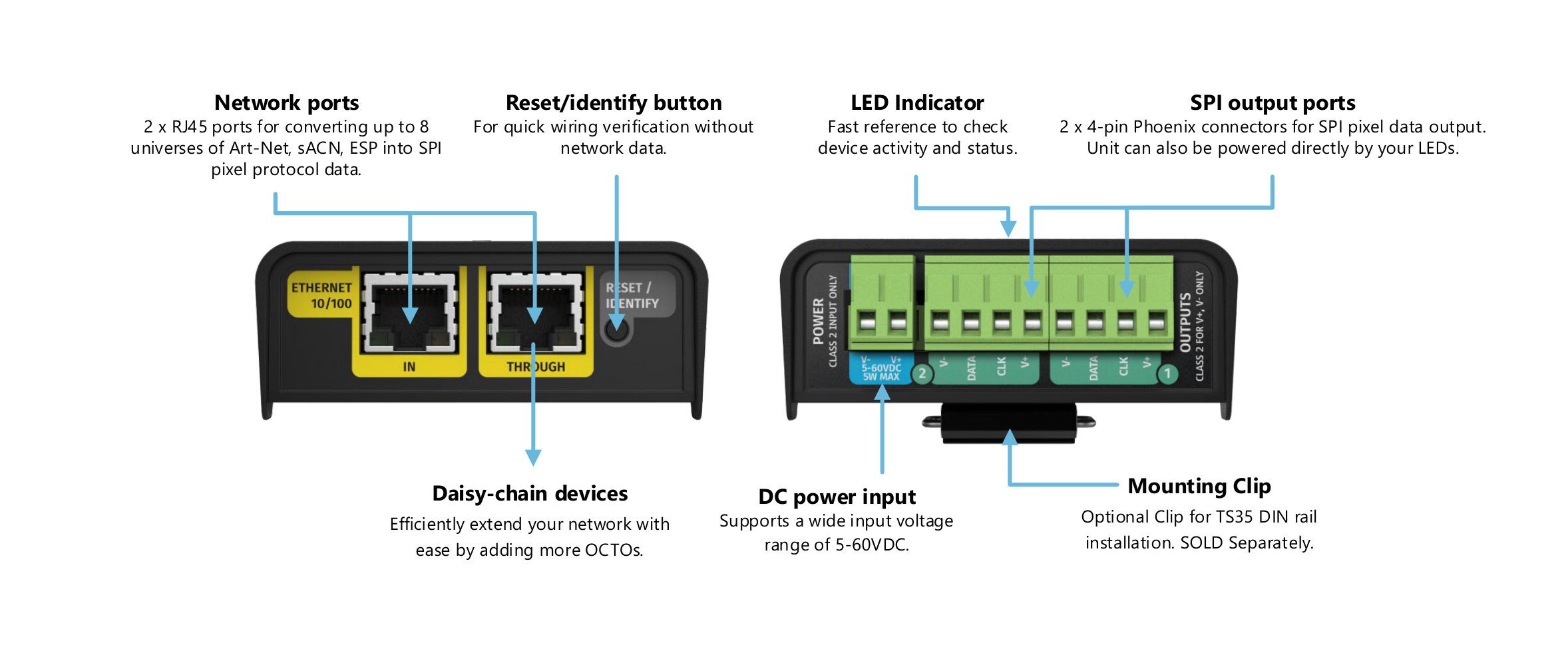
- Network ports — 2 × RJ45 ports for converting up to 8 universes of Art-Net, sACN, ESP into SPI pixel protocol data.
- Reset / Identify button — for quick wiring verification without network data.
- Daisy-chain devices — efficiently extend your network with ease by adding more OCTOs.
- LED indicator — fast reference to check device activity and status.
- SPI output ports — 2 × 4-pin Phoenix connectors for SPI pixel data output. Unit can also be powered directly by your LEDs.
- Mounting clip — optional clip for TS35 DIN-rail installation. Sold separately.
- DC power input — supports a wide input voltage range of 5–60 V DC.
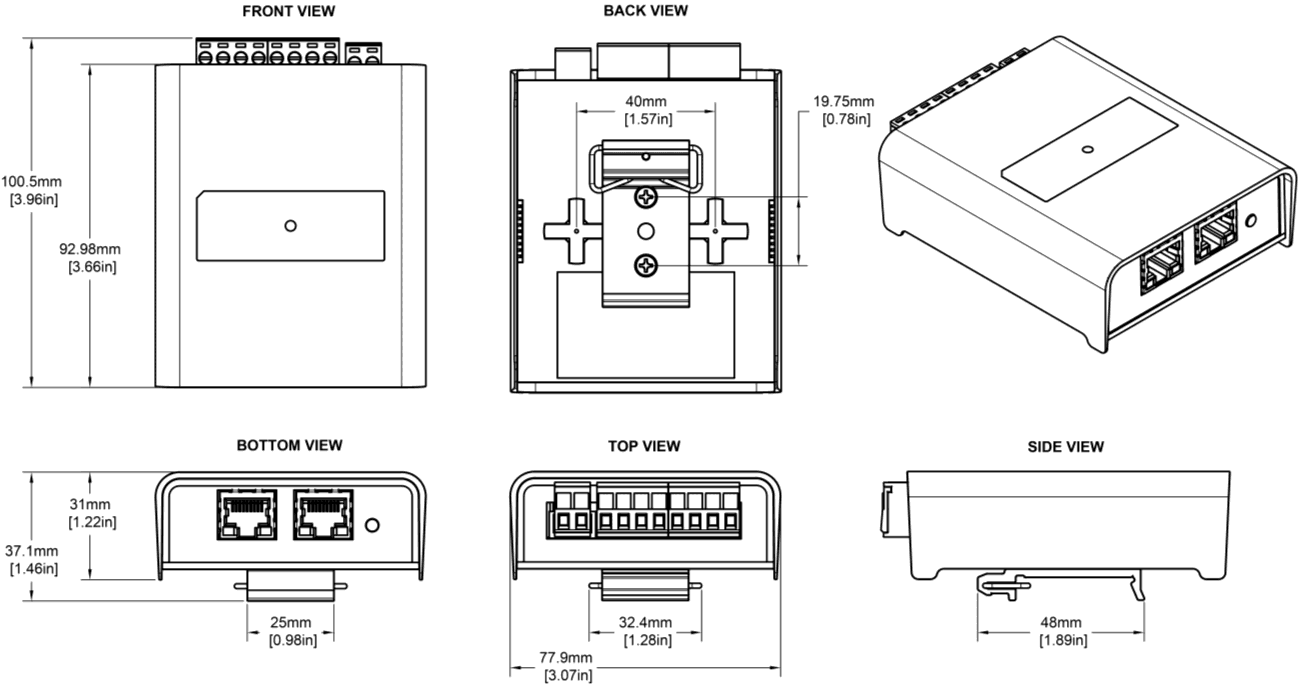
Physical dimensions
Mounting options
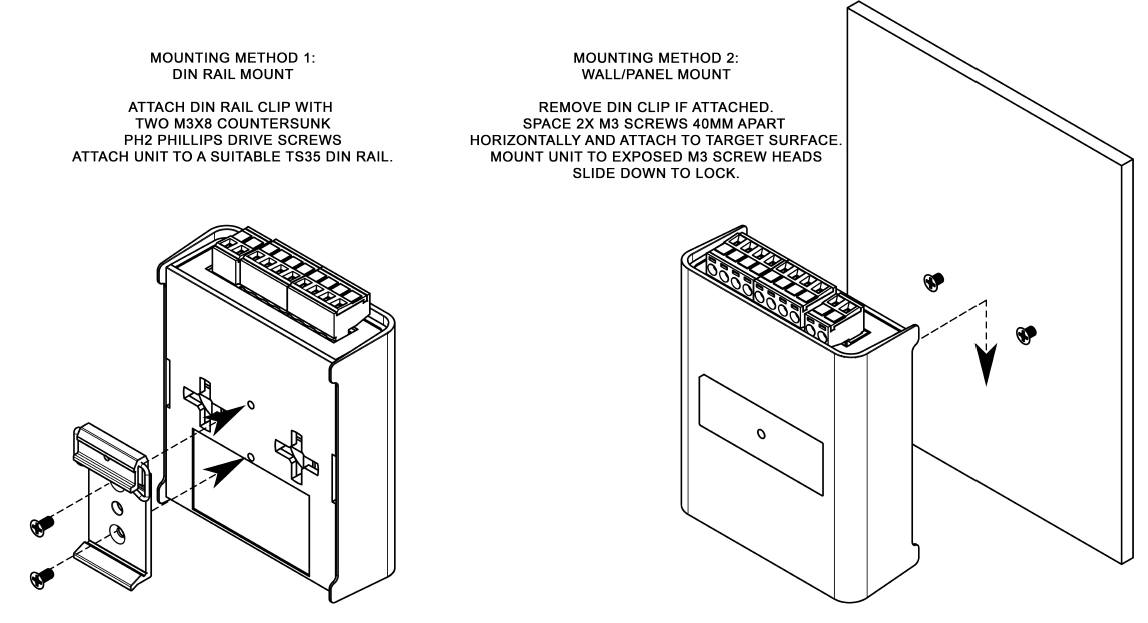
⚠️ Note: The surface mount tabs have been designed to hold the weight of the OCTO LITE only — excess force by cable strain can cause damage.
Application diagram
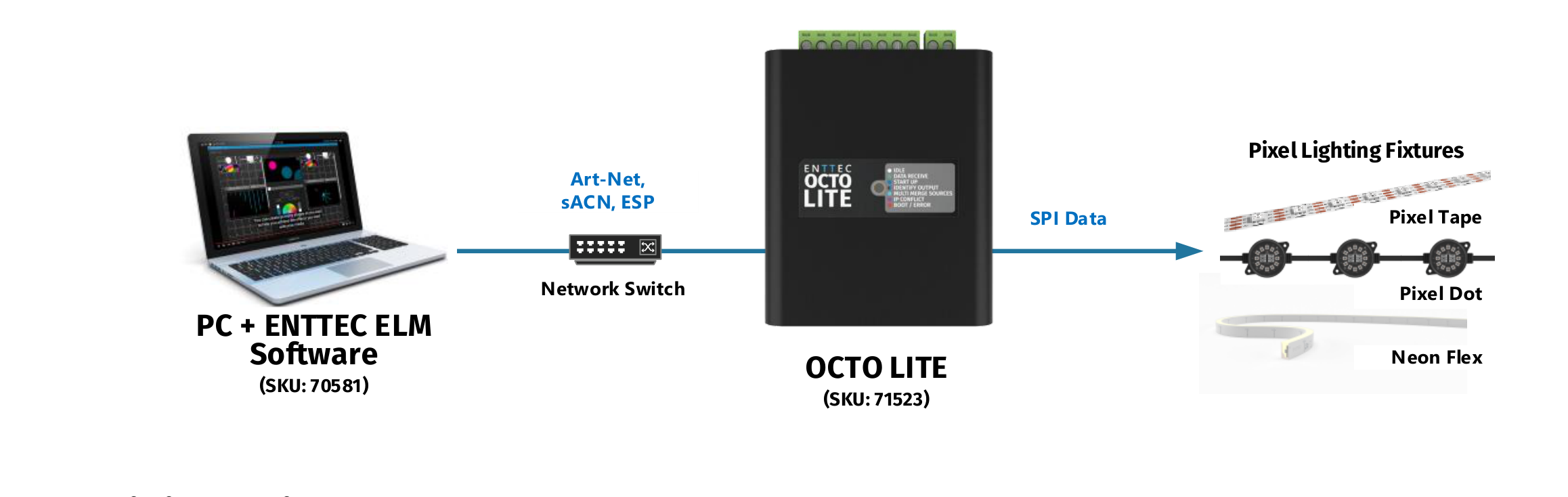
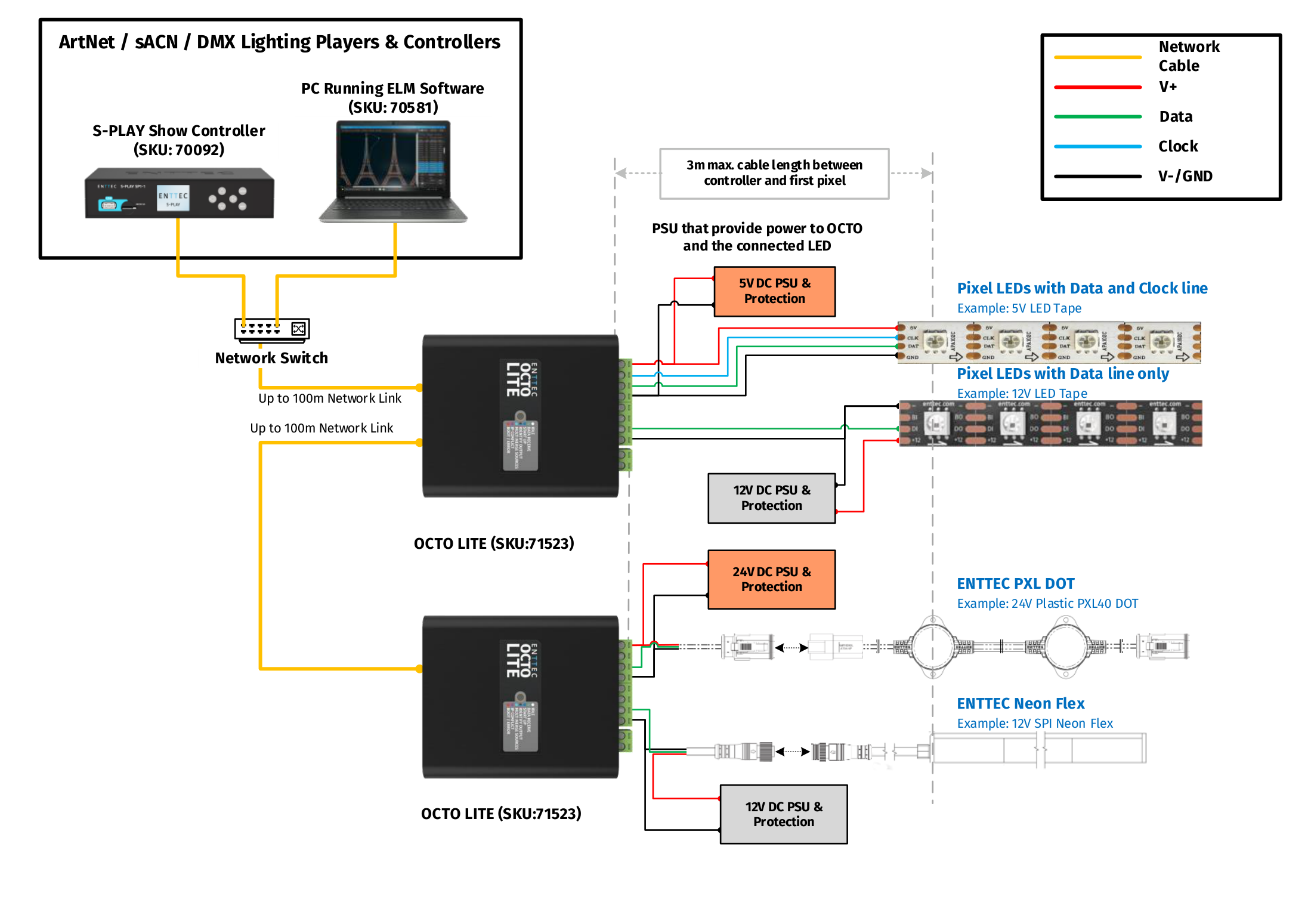
Wiring diagrams
- Locate the OCTO LITE and PSU as close as possible to the first pixel in your chain to reduce the impact of voltage drop.
- To reduce the likelihood of voltage or Electro Magnetic Interference (EMI) being induced on the control signal lines, where possible, run control cabling away from mains electricity or devices that produce high EMI (e.g. air conditioning units). ENTTEC recommends a maximum data cable distance of 3 metres. The lower the cable distance, the lower the impact of voltage drop.
- To ensure a reliable connection, ENTTEC recommends the use of cable ferrules for all stranded cables connected to the OCTO LITE's screw terminals.
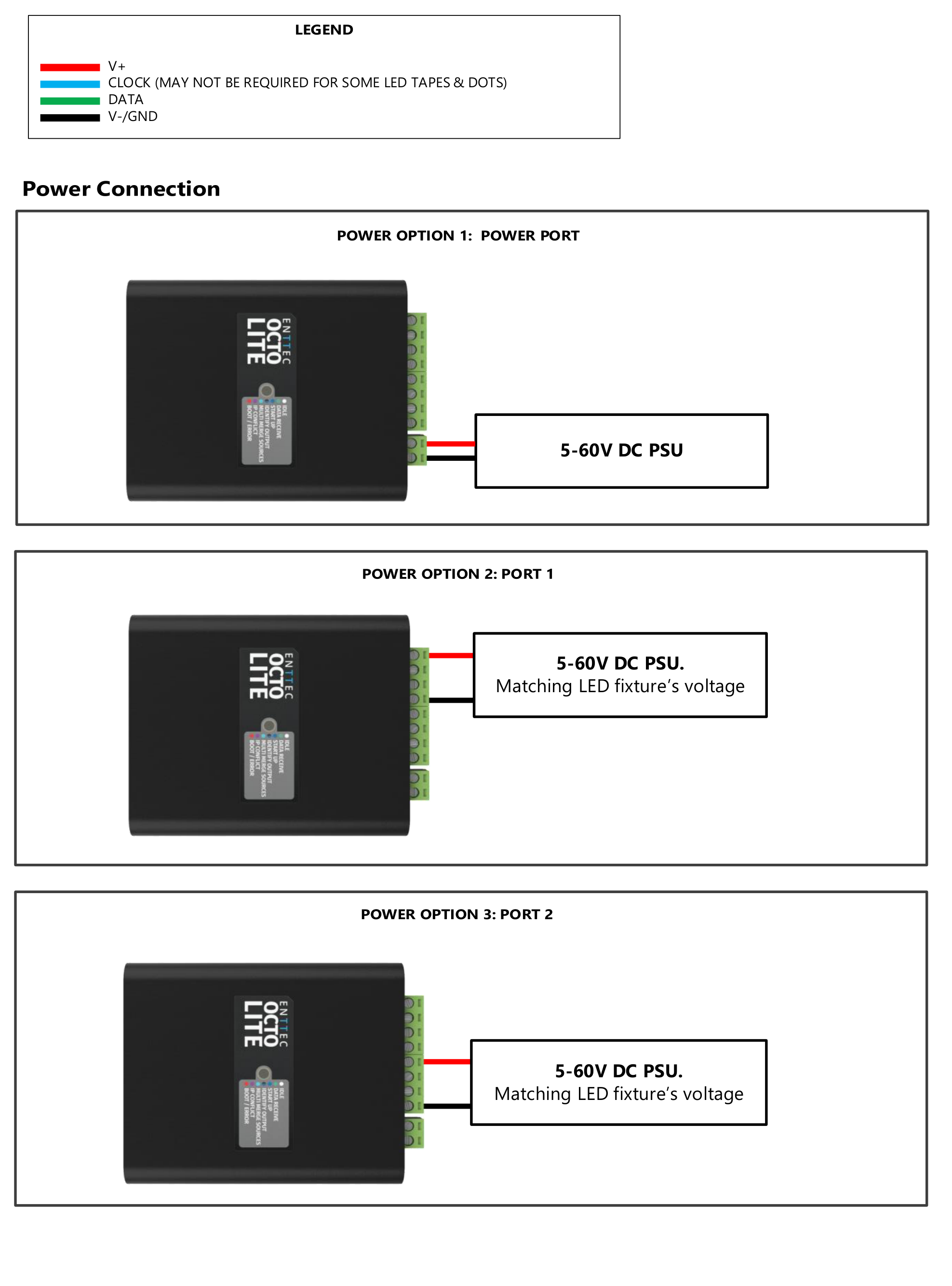
Power input
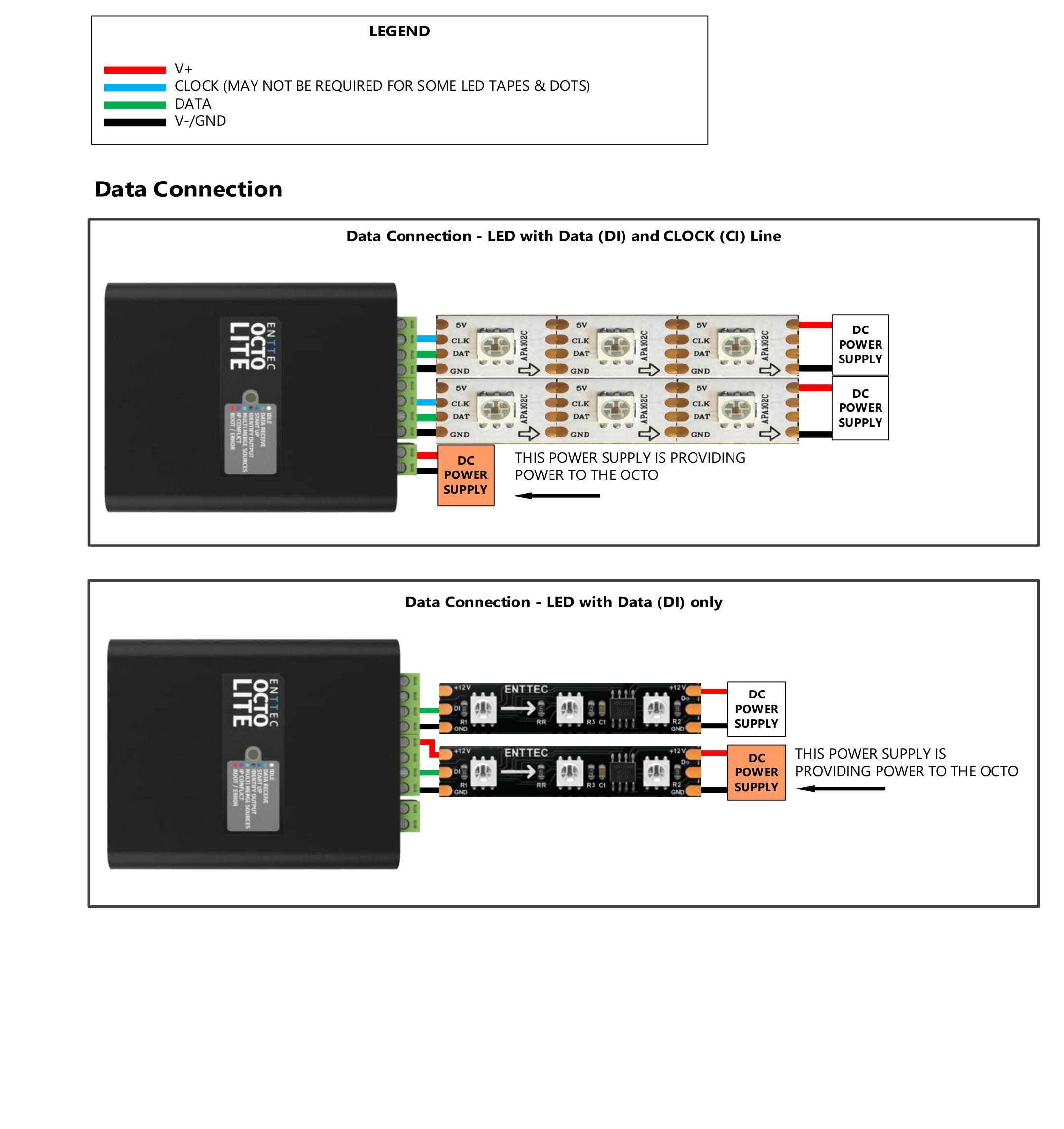
The OCTO LITE is designed for flexibility and compatibility with various LED strip configurations. It supports power backfeed from the LED tape, simplifying wiring and enhancing installation efficiency.
The OCTO LITE offers three power input options, supporting a wide DC voltage range of 5–60 V. Users can choose the most suitable method based on their power supply configuration and LED strip requirements.
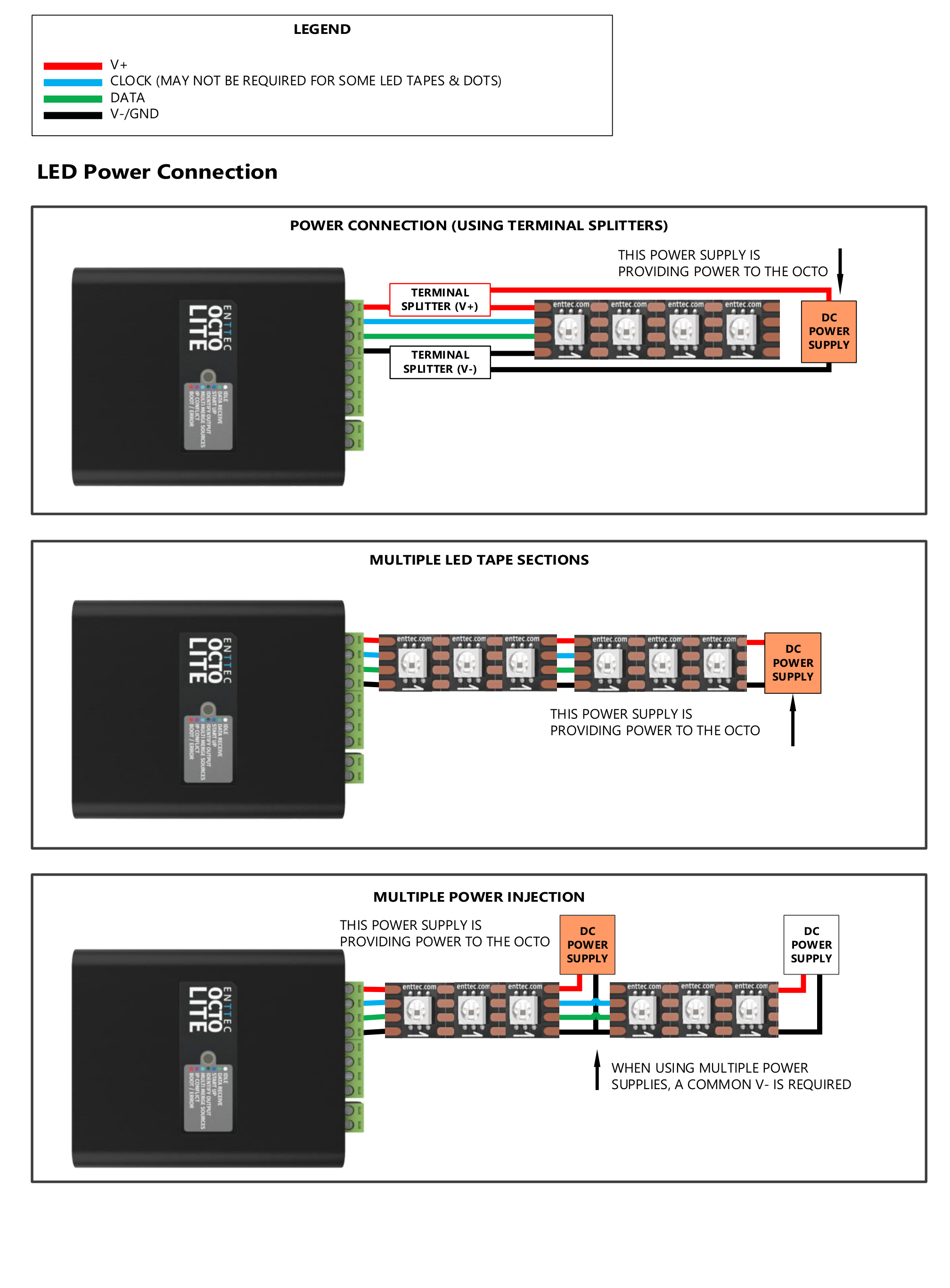
There are also multiple ways to connect and power LED strips and the OCTO LITE depending on the setup and requirements. Users can choose the most suitable method based on their power supply configuration and LED strip specifications. Proper power distribution ensures stable performance and prevents voltage drops across the LED installation.
Data output
OCTO LITE is compatible with LED strips requiring a clock signal, such as those using the APA102 protocol. Each of the 2 output ports supports both data and clock lines, delivering up to 4 universes per port for a total of 8 universes.
Functional features
- Efficiently converts up to 4 universes per port of e-DMX to pixel control protocols.
- Supports up to 8 universe total output.
- Compatible with input protocols: Art-Net, Streaming ACN (sACN) and ESP.
- Works with multiple synchronous and asynchronous pixel output protocols with custom voltage timing.
- Enables creation of custom pixel protocols (refer to the 'Custom Protocol Creation Guide').
- Supports both DHCP and Static IP addressing.
- Includes grouping functionality to reduce input channel count.
- Provides colour order options for RGB, RGBW, and White Pixel.
Hardware features
- Electrically insulated ABS plastic housing.
- Forward-facing LED status indicator.
- Identify / Reset button.
- Pluggable terminal blocks.
- Link & Activity LED indicator built into both RJ45 ports.
- Easily extendable daisy-chain network — up to 8 units for optimum performance between outputs.
- Surface mount or TS35 DIN mount (DIN clip accessory is sold separately).
- Flexible wiring configuration.
LED status indicator
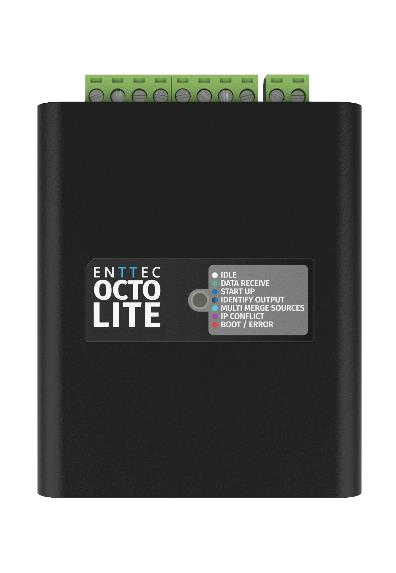
The LED status indicator is used to determine the OCTO LITE's current state which indicates the following device states:
| LED Colour | OCTO LITE Status |
|---|---|
| White | Idle |
| Green | Data receiving |
| Blue | Device starting up |
| Blue (flashing) | Identifying output |
| Cyan | Multiple Merge sources |
| Purple | IP Conflict |
| Red (flashing) | Device in Boot / Error |
Identify / Reset button
The Identify / Reset button on the OCTO LITE can be used to either:
- Identify pixels connection without the need to provide control data. When the button is pressed in standard operation, all 8 output universes are set to output the highest value (255) for 10 seconds before resuming their previous state. This is a convenient test to ensure all outputs are connected and working as intended. This function can also be achieved from our intuitive web interface under the Home tab.
- Reset the OCTO LITE. Refer to the Reset to Factory Defaults section of this document.
Out of the box — factory defaults
| Device name | OCTO LITE |
| DHCP | Enabled. If the DHCP server is slow to respond, or your network does not have a DHCP server, OCTO LITE will fall back to 192.168.0.10. |
| Static IP Address | 192.168.0.10 |
| Gateway IP address | 192.168.0.254 |
| Netmask | 255.255.255.0 |
| Input protocol | Art-Net |
| Output pixel protocol | WS2812B |
| Pixel colour | RGB |
| Both ports | Set to output 4 universes |
| Mapped pixels per port | 680 pixels |
| DMX start address | 1 |
| Global intensity | Set to maximum for eligible protocols: APA-102, TM1814, SJ1221 |
Networking
The OCTO LITE can either be configured to use a DHCP or Static IP address.
DHCP
On power up and with DHCP enabled, if the OCTO LITE is on a network with a device / router with a DHCP server, the OCTO LITE will request an IP address from the server. If the DHCP server is slow to respond, or your network does not have a DHCP server, the OCTO LITE will fall back to the IP address 192.168.0.10 and netmask 255.255.255.0. If a DHCP address is provided, this can be used to communicate with the OCTO LITE.
Static IP
By default (out of the box) the Static IP address will be 192.168.0.10. If the OCTO LITE has DHCP disabled, the Static IP address given to the device will become the IP address to communicate with the OCTO LITE. The Static IP address will change from the default once it's modified in the web interface. Please note down the Static IP address after setting.
⚠️ Note: When configuring multiple OCTO LITEs on a Static network, to avoid IP conflicts, ENTTEC recommends connecting one device at a time to the network and configuring an IP.
- If using DHCP as your IP addressing method, ENTTEC recommends the use of the sACN Multicast, or Art-Net Broadcast. This will ensure that your OCTO LITE continues to receive data if the DHCP server changes its IP address.
- ENTTEC does not recommend unicasting data to a device with its IP address set through the DHCP server on long-term installations.
Web interface
The OCTO LITE is configured through a user-friendly web interface accessible from any modern web browser. For the best experience, it is recommended to use a Chromium-based browser, such as Google Chrome.
Identified IP address
If you already know the OCTO LITE's IP address (whether assigned via DHCP or set as Static), simply enter it directly into the URL field of a web browser to access the device's interface.
Unidentified IP address
If the IP address is unknown, the following discovery methods can be used on a local network to locate the device:
- ENTTEC EMU Software (Windows & macOS 10.13 or later) — this software detects ENTTEC devices on the local network, displays their IP addresses, and allows direct access to the web interface for configuration.
- IP Scanning Software — applications like Angry IP Scanner can scan the local network and return a list of active devices.
- Art Poll Discovery — if using Art-Net, software like DMX Workshop can detect devices through Art Poll.
- Default IP Address — the OCTO LITE's default IP address (192.168.0.10) is printed on the physical product.
⚠️ Note: Since the OCTO LITE hosts a web server on the local network without an SSL certificate (which secures online content), most web browsers will display a "Not secure" warning. This is expected and does not affect functionality.
To ensure proper communication, the eDMX protocols, the controller, and the device used to configure the OCTO LITE must be on the same Local Area Network (LAN) and within the same IP address range as the OCTO LITE.
- For example, if the OCTO LITE is set to its default Static IP address (192.168.0.10), your computer should be assigned an IP such as 192.168.0.20.
- It is also recommended that all devices on the network share the same Subnet Mask for seamless connectivity.
Top menu
The top menu grants easy access to all OCTO LITE web pages, with the active page highlighted in blue.

The top-right corner of the window features installer-friendly buttons:
- Language options — English, Chinese, French, Spanish, and Russian.
- Dark Mode — user interface view option that presents content on a dark background.
- Save Settings — all changes must be saved to take effect. The OCTO LITE takes up to 10 seconds to save.
- Identify — quickly verifies the correct wiring. This is identical to the physical Identify / Reset button on the device. This button on the webpage identifies pixels connected to a specific OCTO LITE without the need to provide control data.
⚠️ Note: The timer will not restart when pressed consecutively.
Home
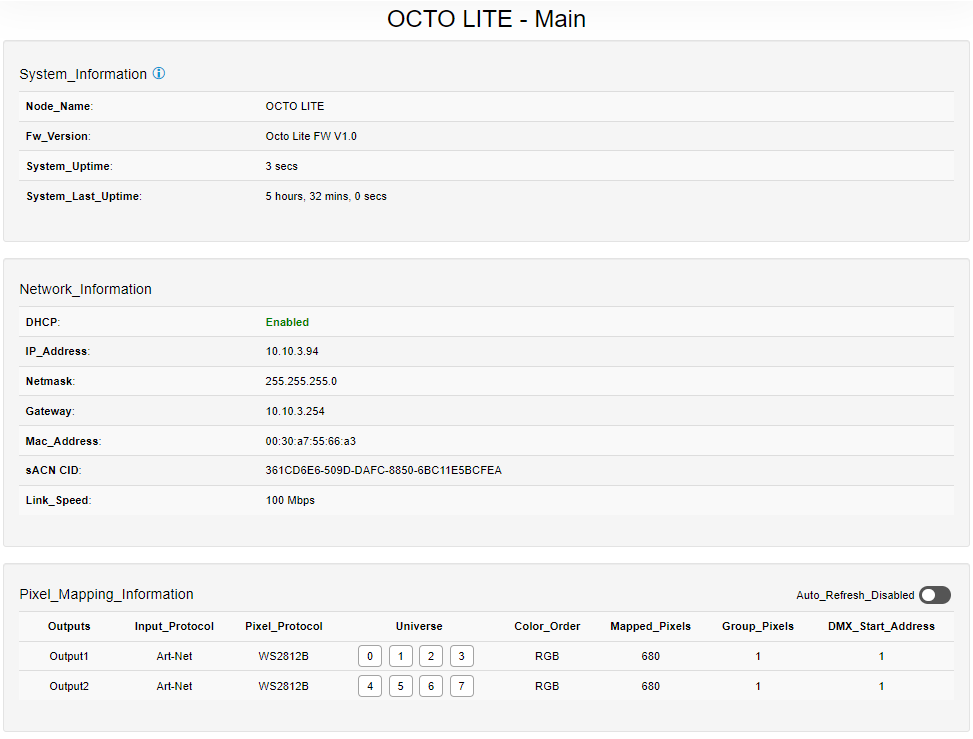
This is the landing page for the OCTO LITE web interface. The Home page displays the current configuration for the following:
System information
- Node Name
- Firmware version on device
- System uptime
- System last uptime
Network information
- DHCP status
- IP address
- Netmask
- Gateway
- Mac Address
- sACN CID
- Link Speed
Pixel mapping information
- Input protocol
- Output Pixel protocol
- Universe
- Colour Order
- Mapped Pixels
- Group Pixels
- DMX Start Address
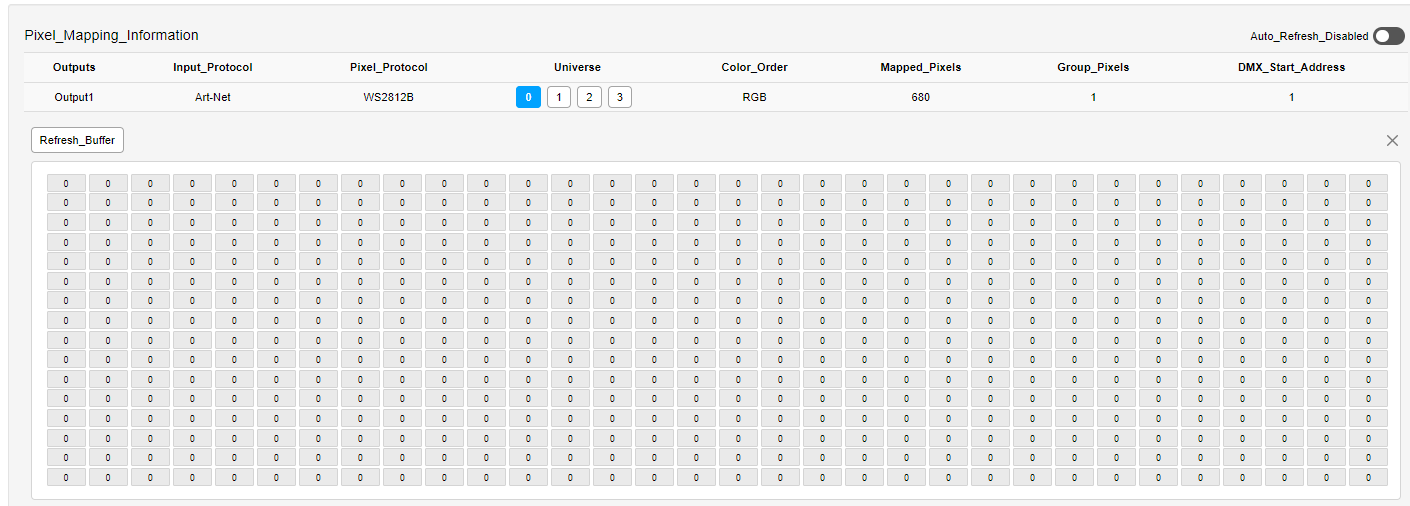
- Universe buffer
Select universe number and enable auto refresh to inspect channel value in real time for the selected universe.
Settings
The OCTO LITE settings can be configured within the Settings tab. Changes will only take effect after being saved — any unsaved changes will be discarded.
Network information
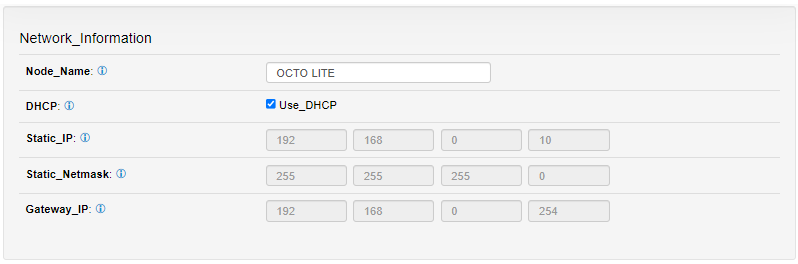
- Node Name — change Node Name for identification.
- DHCP — enabled by default. When enabled, the DHCP server on the network is expected to automatically provide the IP address to the OCTO LITE. When DHCP is enabled but there is no DHCP server or it is slow to respond, the OCTO LITE will fall back to 192.168.0.10.
- Static IP Address / Netmask / Gateway — these are used to set when DHCP is disabled. These options set the Static IP address, Netmask and Gateway IP settings which should be compatible with other devices on the network.
Output settings
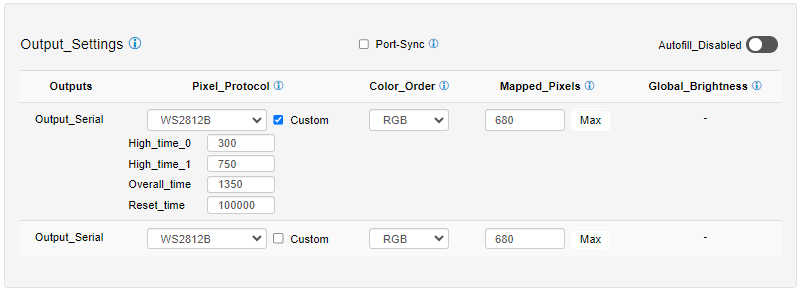
- LED Protocol — select the SPI protocol from the drop-down list or set a custom value that matches the pixels which the OCTO LITE will control. The OCTO LITE provides more than 20 output pixel protocols. Each port can support a different pixel output protocol, allowing you to directly output the selected protocols to your pixel fixtures.
- Custom LED Protocol — tick 'Custom' to enable the LED protocols customisation through voltage timing adjustments on each port setting. By referring to the datasheet of your chosen pixel protocol, you can configure the voltage timing to meet specific requirements and specifications.
⚠️ Note: For creating a custom LED protocol, detailed instructions can be found in the 'Custom Protocol Creation Guide' document available on the ENTTEC website. Certain criteria apply — the eligibility requirements are outlined in the guide.
- Colour Order — configure how RGB / RGBW colours are mapped to pixels.
- Mapped Pixels — define the number of mapped pixels.
- Global Brightness — this is a function of protocols TM1814 and APA-102 that sets their maximum brightness for the tape without hindering the DMX range available.
- Input Protocol — choose between Art-Net, sACN and ESP as the input eDMX protocol.
Pixel mapping options
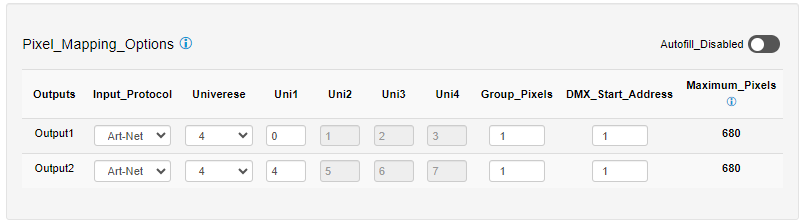
Universes: Max 8U (4U per port). It allows the option of using the same universes for both outputs, such as universes 1, 2, 3, and 4. Alternatively, each output can be configured to use its own set of universes. For example, output 1 can use universes 100, 101, 102, and 103, while output 2 uses universes 1, 2, 3, and 4.
Please note that only the first universe needs to be specified, as the remaining universes (2nd, 3rd … up to 4th) are automatically assigned subsequent universes based on the first one. Example: if the first universe is assigned 9, the 2nd, 3rd and 4th universe will be automatically assigned 10, 11 and 12.
- Art-Net — supports Art-Net 1/2/3/4. Each output port can be assigned a universe number in the range of 0 to 32 767.
- sACN — each output can be assigned a universe number in the range of 1 – 63 999. Please note the OCTO LITE supports a maximum of 1 multicast universe with sACN sync (i.e. all universes set to the same value).
- ESP — each output can be assigned a universe number in the range of 0 – 255. More details of the ESP protocol can be found at www.enttec.com.
Group Pixels: this setting allows multiple pixels to be controlled as one 'virtual pixel'. This reduces the overall amount of input channels required to control pixel strips or dots.
Example: when Group Pixels is set to 10 on an OCTO LITE connected to a length of RGB pixel strip, by patching a single RGB pixel within your control software and sending the values to the OCTO LITE, the first 10 LED pixels would respond to it.
⚠️ Note: The maximum number of physical LED pixels that can be connected to each port is 680 (RGB) or 512 (RGBW). When grouping pixels, the number of control channels required is reduced; this function does not increase the number of physical LED pixels each OCTO LITE can control.
DMX Start Address (DSA): assigns the first DMX channel; this is where the OCTO LITE will start listening for DMX values within the universe. When the universes / output is more than one, the DMX start address only applies to the first universe.
However, where it applies, a start address offset may result in the split of a pixel — e.g. R channel in the first universe and GB channels in the second universe for an RGB LED.
For ease of pixel mapping, ENTTEC recommends offsetting the DMX start address to a number divisible by the number of channels per pixel:
- Increments of 3 for RGB (i.e. 1, 4, 7, 10).
- Increments of 4 for RGBW (i.e. 1, 5, 9, 13).
- Increments of 6 for RGB-16 bit (i.e. 1, 7, 13, 19).
- Increments of 8 for RGBW-16 bits (i.e. 1, 9, 17, 25).
Save & Update
- Reset to Defaults — this button allows the OCTO LITE reset back to factory default via the web interface. Please refer to the Reset to Factory Defaults section of this document.
- Reboot — please allow up to 10 seconds for the device to reboot. When the web interface page refreshes the OCTO LITE is ready.

Network stats
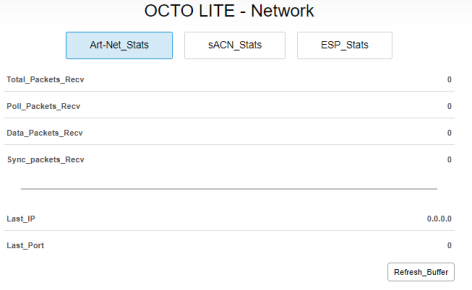
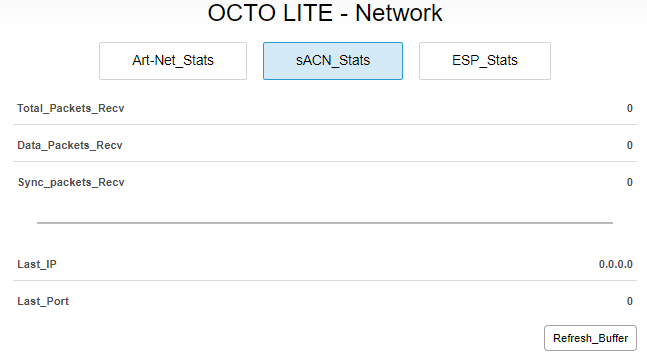
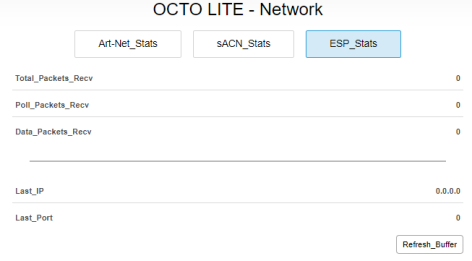
The Network Stats page shows statistics for the input DMX protocol selected. The information provided is:
Art-Net
- Total Packets Received
- Poll Packets Received
- Data Packets Received
- Sync Packets Received
- Last IP where Art-Net packets were received
- Last Port data received from
sACN
- Total Packets Received
- Data Packets Received
- Sync Packets Received
- Last IP where sACN packets were received
- Last Port data received from
ESP
- Total Packets Received
- Poll Packets Received
- Data Packets Received
- Last IP where ESP packets were received
- Last Port data received from
Updating firmware
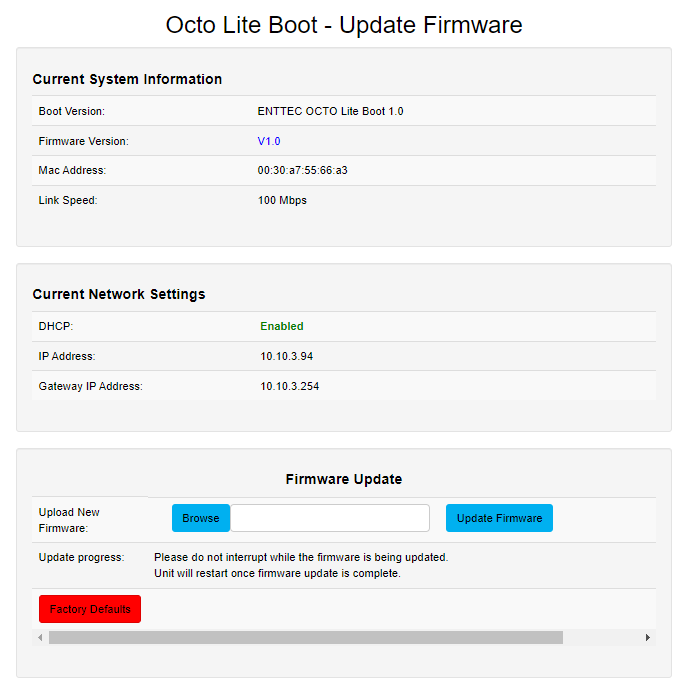
When selecting the Update Firmware tab, the OCTO LITE will stop outputting, and the web interface boots into the Update Firmware mode. It may take a while depending on the network setting.
This will display basic information regarding the device including current Firmware Version, Mac Address and IP address information.
The latest firmware can be downloaded from www.enttec.com. Use the Browse button to select an OCTO LITE firmware from your computer. OCTO LITE firmware files have a .bin extension.
Next, click on the Update Firmware button to begin updating.
After the update has been completed, the web interface will load the Home tab, where you can check the update was successful under Firmware Version. Once the Home tab has loaded, the OCTO LITE will resume operation.
Reset to factory defaults
The OCTO LITE can be reset by either the web interface or the reset button on the device. It resumes the device's settings back to factory default.
Resetting via the web interface
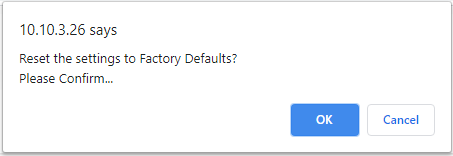
The Reset to Defaults command can be found under the Settings tab of the OCTO LITE's locally hosted web interface.
Once the command is pressed, a pop-up would appear as shown in the image below:
Resetting by the reset button
The reset button on the device restores the network configuration of the OCTO LITE to factory defaults. To reset to factory defaults, the following procedure must be performed:
- Power off the unit.
- Press and hold the Reset button.
- While holding the Reset button, power up the unit.
- Keep holding the button and release the Reset button after the LED turns yellow.
- Power cycle the unit.
Frequently asked questions
I'm unable to connect to the OCTO LITE web interface.
Ensure that the OCTO LITE and your computer are on the same subnet. To troubleshoot:
- Connect the OCTO LITE directly to your computer using a Cat5/6 cable and power it on.
- Give your computer a Static IP address (e.g. 192.168.0.20).
- Change computer Netmask to 255.255.255.0.
- Open ENTTEC EMU software.
- Once EMU finds the OCTO LITE, you will be able to open the device webpage and configure it.
Factory reset the device using the reset button if the above steps do not resolve the issue.
The OCTO LITE's factory default resets the OCTO LITE to static IP address 192.168.0.10 and netmask 255.255.255.0 with DHCP enabled.
When the OCTO LITE has DHCP enabled but the DHCP server is unavailable (e.g. the device is connected to a computer without a DHCP server), the IP address will fall back to 192.168.0.10 with netmask 255.255.255.0.
What if my LED strip protocol is not on the drop-down list? How to add a new LED strip protocol to OCTO LITE?
The OCTO LITE allows the user to choose a pixel output protocol even if it is not found in the drop-down list. Visit the ENTTEC website to view the 'OCTO LITE Custom Protocol Creation Guide' document for more information about the key criteria and the step-by-step custom protocol creation guide.
What is the minimum DC voltage for powering the OCTO LITE?
The minimum DC voltage the OCTO LITE requires to run is 5 V.
⚠️ Servicing, inspection & maintenance
- The device has no user serviceable parts. If your installation has become damaged, the device should be replaced.
- Power down the device and ensure a method is in place to stop the system from becoming energised during servicing, inspection & maintenance.
Key areas to examine during inspection
- Ensure all connectors are mated securely and show no sign of damage or corrosion.
- Ensure all cabling has not obtained physical damage or been crushed.
- Check for dust or dirt build-up on the device and schedule cleaning if necessary.
- Dirt or dust build-up can limit the ability of a device to dissipate heat and can lead to damage.
The replacement device should be installed in accordance with all steps within the installation guide. To order replacement devices or accessories contact your reseller or message ENTTEC directly.
Cleaning
Dust and dirt buildup can limit the ability of the device to dissipate heat resulting in damage. The device must be cleaned in a schedule fit for the environment it is installed within to ensure maximum product longevity. Cleaning schedules will vary greatly depending on the operating environment. Generally, the more extreme the environment, the shorter the interval between cleanings.
⚠️ Before cleaning:
- Before cleaning, power down your system and ensure a method is in place to stop the system from becoming energised until cleaning is complete.
- Do not use abrasive, corrosive, or solvent-based cleaning products on a device.
- Do not spray devices or accessories. The device is an IP20 product.
To clean an ENTTEC device, use low-pressure compressed air to remove dust, dirt and loose particles. If deemed necessary, wipe the device with a damp microfibre cloth.
A selection of environmental factors that may increase the need for frequent cleaning
- Use of stage fog, smoke or atmospheric devices.
- High airflow rates (i.e. in close proximity to air conditioning vents).
- High pollution levels or cigarette smoke.
- Airborne dust (from building work, the natural environment or pyrotechnic effects).
If any of these factors are present, inspect all elements of the system soon after installation to see whether cleaning is necessary, then check again at frequent intervals. This procedure will allow you to determine a reliable cleaning schedule for your installation.
Package content
- OCTO LITE
Ordering information
For further support and to browse ENTTEC's range of products visit the ENTTEC website.
| Item | SKU |
|---|---|
| OCTO LITE | 71523 |
| OCTO LITE Accessory Pack (5-Pin WAGO × 2, DIN Clip × 1, Screw × 2) | 51534 |
⚠️ Note: Due to constant innovation, information within this document is subject to change.