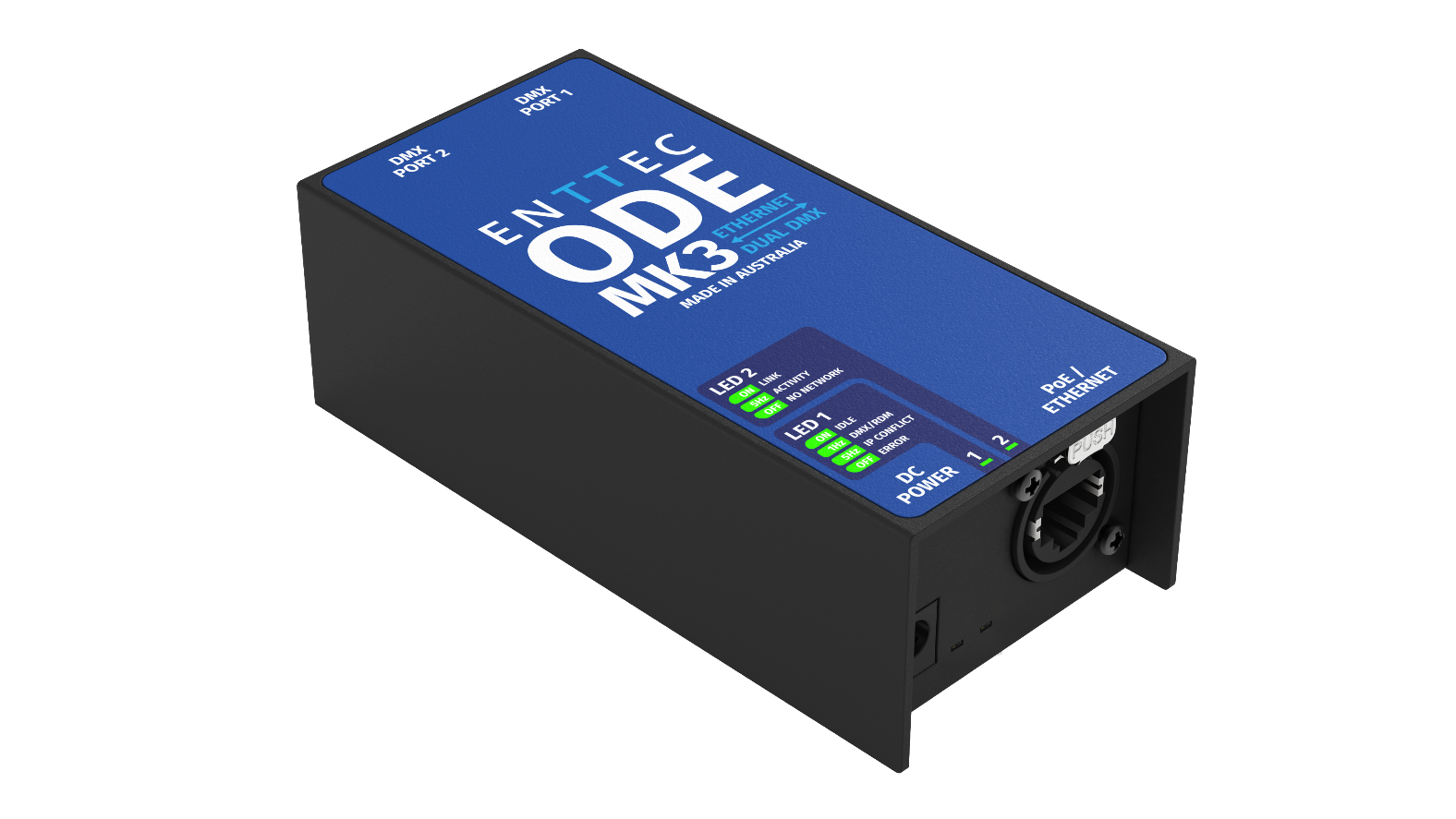
Two-Universe bi-directional eDMX – DMX/RDM controller supporting Power over Ethernet (PoE).
⚠️ Safety
Ensure you are familiarised with all key information within this guide and other relevant ENTTEC documentation before specifying, installing, or operating an ENTTEC device. If you are in any doubt about system safety, or you plan to install the device in a configuration that is not covered within this guide, contact ENTTEC or your ENTTEC supplier for assistance.
⚠️ Heads up: ENTTEC's return-to-base warranty for this product does not cover damage caused by inappropriate use, application, or modification to the product.
⚡ Electrical safety
- This product must be installed in accordance with applicable national and local electrical and construction codes by a person familiar with the construction and operation of the product and the hazards involved. Failure to comply may result in death or serious injury.
- Do not exceed the ratings and limitations defined in the product datasheet or this document. Exceeding can cause damage to the device, risk of fire and electrical faults.
- Ensure that no part of the installation is or can be connected to power until all connections and work is complete.
- Before applying power, check that all power distribution equipment and cables are in perfect condition and rated for the current requirements of all connected devices and verify it is appropriately fused and voltage is compatible.
- Remove power from your installation immediately if accessories, power cables or connectors are in any way damaged, defective, show signs of overheating or are wet.
- Provide a means of locking out power to your installation for system servicing, cleaning, and maintenance. Remove power when not in use.
- Ensure your installation is protected from short circuits and overcurrent. Loose wires around this device during operation could result in short circuiting.
- Do not over-stretch cabling to the device's connectors and ensure cabling does not exert force on the PCB.
- Do not 'hot swap' or 'hot plug' power to the device or its accessories.
- Do not connect any of this device's V- (GND) connectors to earth.
- Do not connect this device to a dimmer pack or mains electricity.
⚠️ System planning and specification
- Where possible, keep this device out of direct sunlight to maintain optimal operating temperature.
- Use twisted-pair, 120 Ω, shielded EIA-485 cable for DMX512 data. Conductors should be 24 AWG (7/0.2) or larger for mechanical strength and to minimise voltage drop on long lines.
- A maximum of 32 devices on a DMX line before re-generating the signal using a DMX buffer / repeater / splitter.
- Always terminate DMX chains using a 120 Ω resistor to stop signal degradation or data bounce-back.
- Maximum recommended DMX cable run is 300 m (984 ft).
- Avoid running data cabling close to sources of electromagnetic interference (EMI).
- This device has an IP20 rating and is not designed to be exposed to moisture or condensing humidity.
- Operate the device within the specified ranges in its product datasheet.
⚠️ Protection from injury during installation
- Installation must be performed by qualified personnel. If unsure, consult a professional.
- Always work with a plan of the installation that respects all system limitations.
- Keep the ODE MK3 and its accessories in its protective packaging until final installation.
- Note the serial number of each ODE MK3 and add it to your layout plan for future reference when servicing.
- All network cabling should be terminated with an RJ45 connector to the T-568B standard.
- Always use suitable personal protective equipment when installing ENTTEC products.
- Once installation is completed, check that all hardware and components are securely in place and fastened to supporting structures if applicable.
⚠️ Installation safety guidelines
- The device is convection-cooled — ensure sufficient airflow so heat can be dissipated.
- Do not cover the device with insulating material of any kind.
- Do not operate the device if the ambient temperature exceeds that stated in the device specifications.
- Do not cover or enclose the device without a suitable and proven method of dissipating heat.
- Do not install the device in damp or wet environments.
- Do not modify the device hardware in any way.
- Do not use the device if you see any signs of damage.
- Do not handle the device in an energised state.
- Do not crush or clamp the device during installation.
- Do not sign off a system without ensuring all cabling to the device and accessories has been appropriately restrained, secured and is not under tension.
Wiring diagrams
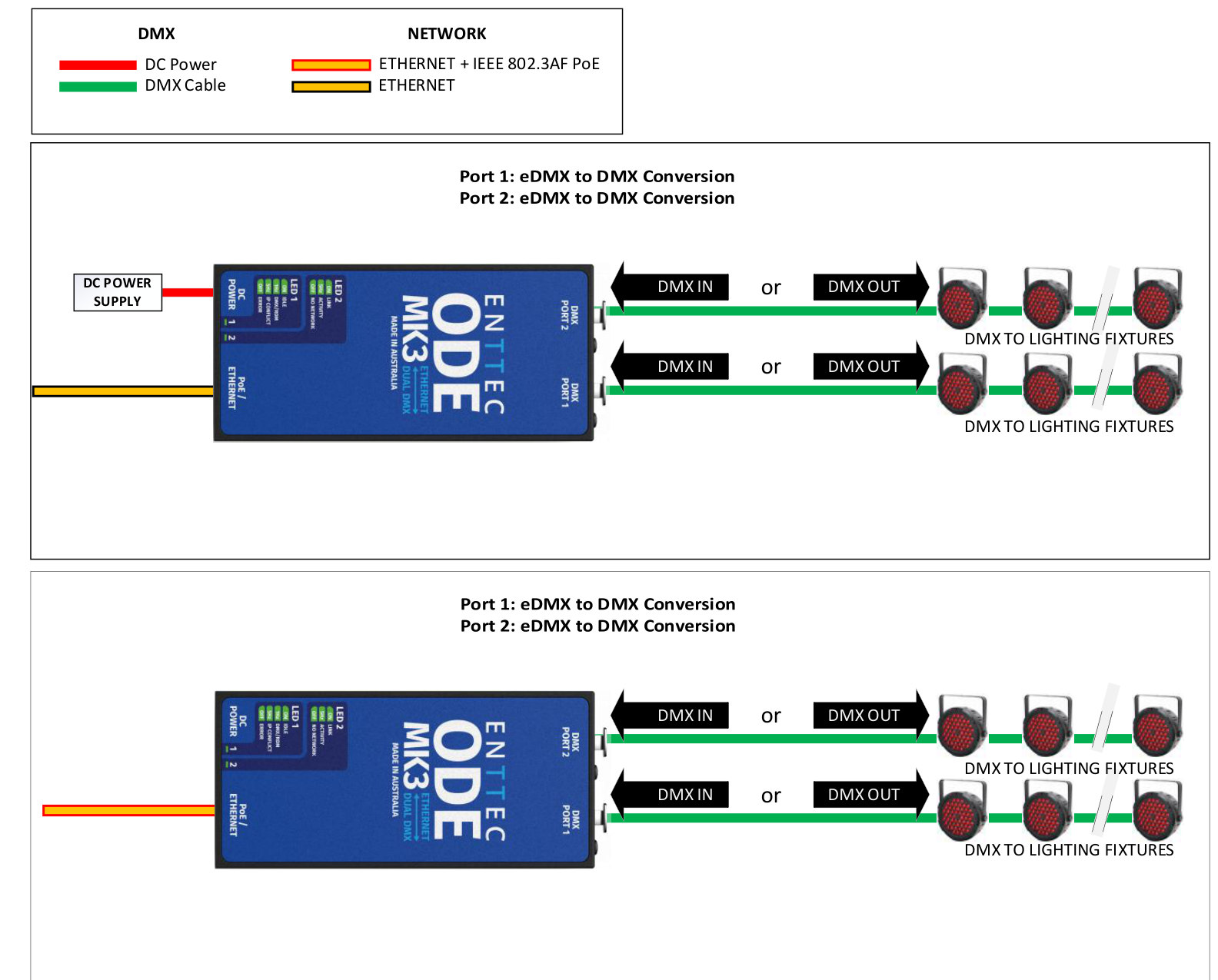
Each of the two 5-pin XLR ports can act as DMX input or DMX output, configurable from the web interface. The device accepts PoE on the Ethernet port or DC power via the barrel jack.
Functional features
- Two bi-directional DMX ports with E1.20 RDM support.
- Support for Art-Net, sACN, and ESP to DMX conversion.
- HTP / LTP merging support for simultaneous DMX sources.
- Configurable DMX output refresh rate.
- Intuitive device configuration and updates through the inbuilt web interface.
- 'Current Port Buffer' allows live DMX values to be viewed.
Bi-directional eDMX protocols and USITT DMX512-A conversion
The ODE MK3's primary functionality is to convert between Ethernet-DMX protocols and USITT DMX512-A (DMX). The ODE MK3 can support eDMX protocols including Art-Net, sACN and ESP which can be received and converted to DMX with the HTP or LTP merging options, or DMX converted to eDMX protocols with the options to unicast or broadcast/multicast.
Art-Net <-> DMX (RDM supported): Art-Net 1, 2, 3 & 4 are supported. Universe in the range of 0 to 32767.
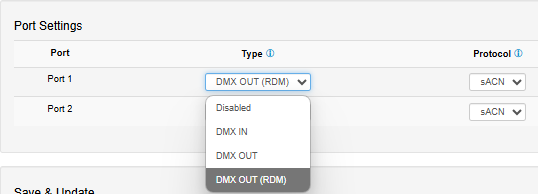
RDM (ANSI E1.20): when the ODE MK3 port type is set to 'DMX Out (RDM)' and configured with Art-Net as the Protocol, it allows ART-RDM. This allows the ODE MK3 to act as a gateway, facilitating the discovery, configuration, and monitoring of RDM-enabled devices on the DMX line by RDM solutions.
⚠️ Note:
- The device functions as a gateway and does not support remote configuration through Art-Net.
- ENTTEC advises disabling RDM when not needed for your fixtures. Older fixtures compatible with the DMX 1990 Specification may exhibit erratic behaviour with RDM packets present on the DMX line.
sACN <-> DMX: sACN is supported. Each port's configuration can be defined using the ODE MK3's web interface to define a universe in the range 0 to 63999. sACN priority of the output can be defined (default priority: 100). The ODE MK3 supports a maximum of 1 multicast universe with sACN sync (i.e. both universe outputs set to the same universe).
ESP <-> DMX: ESP is supported. Each port's configuration can be defined using the ODE MK3's web interface to define a universe in the range 0 to 255.
The additional flexibility that the ODE MK3 can provide means that each of the two ports can be configured individually:
- Both outputs can be specified to use the same universe and protocol, i.e., both outputs can be set to output use universe 1.
- Each output is not required to be sequential, i.e. port one can be set to universe 10, port two can be set to input universe 3.
- Protocol or data conversion direction doesn't have to be the same for each port.
Merging
Merging is available when the ODE MK3 port type is set to 'DMX Out'. Two different Ethernet-DMX sources (from different IP addresses) values can be merged if the source is the same protocol and universe.
If the ODE MK3 receives more sources than expected (Disabled – 1 source & HTP/LTP – 2 sources) the extra sources (e.g. if set to HTP then the 3rd source) will be ignored. The ODE MK3 will display a warning on the home page of the web interface and the status LED will blink at a high rate.
Whilst set to HTP or LTP merging, if either one of the 2 sources stop being received, the failed source is held in the merge buffer for 4 seconds. If the failed source returns the merge will continue, otherwise it will be discarded.
Merging options include:
| Mode | Behaviour |
|---|---|
| None | No merging. Only one source should be sending to the DMX output. |
| HTP Merge | Highest Takes Precedence. Channels are compared one to one and the highest value is set on the output. |
| LTP Merge | Latest Takes Precedence. The source with the latest change in data is used as the output. |
Hardware features
- Electrically insulated ABS plastic housing.
- 2 × 5-Pin Female XLR for bi-directional DMX ports.
- 1 × RJ45 EtherCon connection.
- 1 × 12–24 V DC jack.
- 2 × LED indicators: Status and Link/Activity.
- IEEE 802.3af PoE (Power over Ethernet) or 12–24 V DC jack input.
DMX connectors
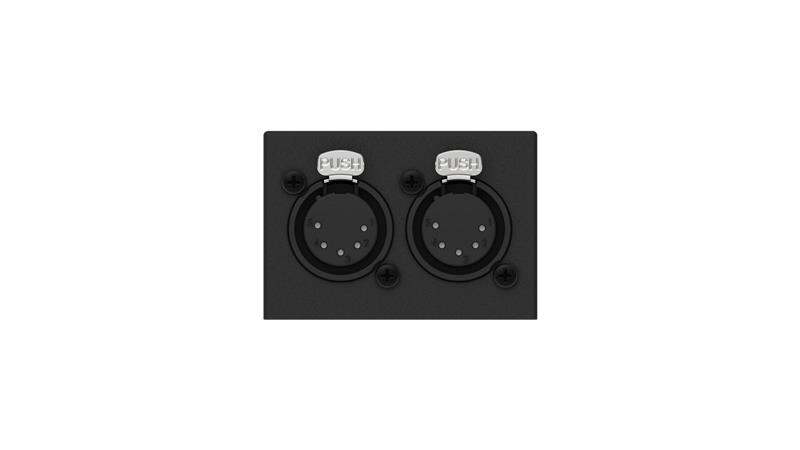
The ODE MK3 features two 5-pin female XLR bi-directional DMX ports, which can be used either for DMX in or DMX out, depending on the settings set within the web interface.
5-pin DMX OUT / DMX IN:
| Pin | Signal |
|---|---|
| Pin 1 | 0 V (GND) |
| Pin 2 | Data − |
| Pin 3 | Data + |
| Pin 4 | NC |
| Pin 5 | NC |
You can use any 3-to-5-pin DMX adaptor to connect to 3-pin DMX cables or fixtures. Ensure you check the pinout before connecting to any DMX connector.
LED status indicator
ODE MK3 comes with two LED indicators located between the DC jack input and the RJ45 EtherCon connector.
LED 1 — Status indicator which blinks to indicate the following:
| Frequency | Status |
|---|---|
| On | IDLE |
| 1 Hz (1 blink every 1 second) | DMX / RDM |
| 5 Hz (1 blink every 0.2 seconds) | IP CONFLICT |
| Off | ERROR |
LED 2 — Network status indicator which blinks to indicate the following:
| Frequency | Status |
|---|---|
| On | LINK |
| 5 Hz (1 blink every 0.2 seconds) | ACTIVITY |
| Off | NO NETWORK |
⚠️ Note: If both LEDs blink at the same 1 Hz frequency, it indicates the ODE MK3 requires a firmware update or a reboot.
PoE (Power over Ethernet)
The ODE MK3 supports IEEE 802.3af Power over Ethernet. This allows the device to be powered via the RJ45 Ethernet connection, reducing the number of cables and the ability to remotely deploy the ODE MK3 without the need for a local power source close to the device.
PoE can be introduced to the Ethernet cable either through a network switch which outputs PoE under the IEEE 802.3af standard, or through an IEEE 802.3af PoE injector.
⚠️ Note:
- DC power input takes precedence over PoE. If the DC power is disconnected, the ODE MK3 will typically switch to PoE in about 3 seconds. However, with older hardware, this process may take up to 1 minute.
- Passive PoE is not compatible with the ODE MK3.
Out of the box
The ODE MK3 device default settings as below:
| Device Name | ODE MK3 |
| DHCP | Enabled |
| Static IP | 192.168.0.10 / Netmask 255.255.255.0 |
| Both ports | Set to DMX OUT |
| Protocol | Set to Art-Net |
| Merging | None |
| Port 1 | Universe 0 |
| Port 2 | Universe 1 |
| RDM | Enabled |
Networking
The ODE MK3 can either be configured to be a DHCP or Static IP address.
DHCP
On power up and with DHCP enabled, if the ODE MK3 is on a network with a device/router with a DHCP server, the ODE MK3 will request an IP address from the server. If the DHCP server is slow to respond, or your network does not have a DHCP server, the ODE MK3 will fall back to the default IP address 192.168.0.10 and netmask 255.255.255.0. If a DHCP address is provided, this can be used to communicate with the ODE MK3.
Static IP
By default (out of the box) the Static IP address will be 192.168.0.10. If the ODE MK3 has DHCP disabled, the Static IP address given to the device will become the IP address to communicate with the ODE MK3. The Static IP address will change from the default once it's modified in the web interface. Please note down the Static IP address after setting.
⚠️ Note: When configuring multiple ODE MK3's on a Static network; to avoid IP conflicts, ENTTEC recommends connecting one device at a time to the network and configuring an IP.
If using DHCP as your IP addressing method, ENTTEC recommends the use of the sACN protocol, or Art-Net Broadcast. This will ensure that your ODE MK3 continues to receive data if the DHCP server changes its IP address.
ENTTEC does not recommend unicasting data to a device with its IP address set through the DHCP server on long-term installations.
Web interface
Configuring the ODE MK3 is done through a web interface which can be brought up on any modern web browser. A Chromium-based browser (i.e. Google Chrome) is recommended for accessing the ODE MK3 web interface.
Identified IP address:
If you are aware of the ODE MK3 IP address (either DHCP or Static), then the address can be typed directly into the web browser's URL field.
Unidentified IP address:
If you are not aware of the ODE MK3's IP address (either DHCP or Static) the following discovery methods can be used on a local network to discover devices:
- ENTTEC EMU software (available for Windows and MacOS), which will discover ENTTEC devices on the Local Area Network, will display their IP addresses and open to the web interface before opting to configure the device.
- An IP scanning software application (i.e. Angry IP Scanner) can be run on the local network to return a list of active devices on a local network.
- Devices can be discovered using Art Poll (i.e. DMX Workshop if set to use ArtNet).
- The device Default IP address 192.168.0.10 is printed on the physical label on the rear of the product.
⚠️ Note: As the ODE MK3 is hosting a web server on the local network and does not feature an SSL Certificate (used to secure online content), the web browser will display the 'Not secure' warning, this is to be expected.
Ensure the controller and configuration device for the ODE MK3 share the same LAN and IP address range. For example, if the ODE MK3 is set to 192.168.0.10, your computer should be around 192.168.0.20. Keep consistent Subnet Mask settings across all network devices.
Top menu

The top menu grants easy access to all ODE MK3 web pages, with the active page highlighted in blue. The top right corner of the window features 2 installer-friendly buttons:
- Dark Mode — user interface view option that presents content on a dark background.
- Identify — an Identify button is available to quickly verify the correct wiring. This button on the webpage identifies fixtures connected to a specific ODE MK3 without the need to provide control data. The timer will not restart when pressed consecutively.
Home tab
The landing page for the ODE MK3 web interface is the Home tab. This tab is designed to give you a read-only device overview. This will display:
System Information:
- Node Name
- Firmware Version
- System uptime
- System last uptime
Current Network Settings:
- DHCP Status
- IP Address
- NetMask
- Gateway Address
- Mac Address
- Link Speed
Current Port Settings:
- Port
- Type
- Protocol
- Universe — it displays a snapshot of all current DMX values by clicking the universe number
- Refresh Rate
- Output Merging
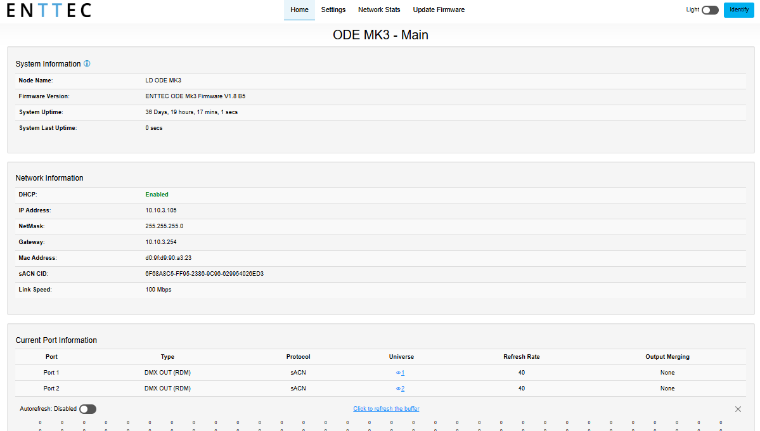
Settings tab
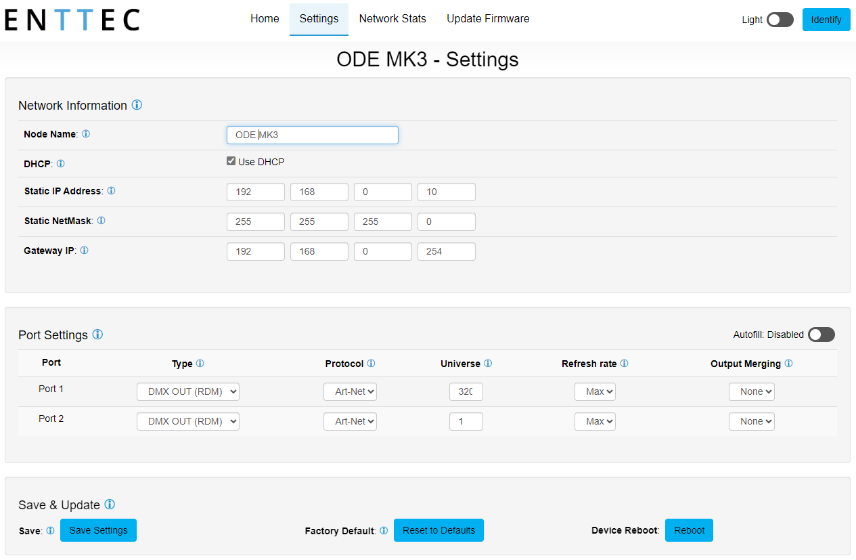
The ODE MK3 settings can be configured within the Settings tab. Changes will only take effect after being saved; any unsaved changes will be discarded.
- Node Name — the name of ODE MK3 will be discoverable within Poll replies.
- DHCP — enabled by default. When enabled, the DHCP server on the network is expected to automatically provide the IP address to the ODE MK3. If no DHCP router/server is present or DHCP is disabled, the ODE MK3 will fall back to 192.168.0.10.
- Static IP Address / Static NetMask / Gateway — these are used if DHCP is disabled. These options set the Static IP address. These settings should be set to be compatible with other devices on the network.
Port Settings:
This is where users can set individual port configuration or enable the 'Autofill' function to manage group port settings. Any port settings after the one changed will autofill to match unless it has already been changed. Autofill isn't applied to DMX universes.
Type: choose from the following options:
- Disabled — will not process any DMX (input or output).
- DMX IN — will convert DMX from the 5-pin XLR to an Ethernet-DMX protocol.
- DMX OUT — will convert an Ethernet-DMX protocol to DMX on the 5-pin XLR.
- DMX OUT (RDM) — this is only available when the Protocol is Art-Net and sACN. More information can be found in the Functional Features section of this document.
- Protocol — choose between Art-Net, sACN and ESP as the Protocol.
- Universe — set the Ethernet-DMX protocol's input Universe.
- Refresh Rate — the rate at which the ODE MK3 will output the data from its DMX port (40 Frames per second is default). It will repeat the last received frame to comply with the DMX standard.
Options:
Additional configuration is available depending on port type and protocol.
- Input Broadcast / Unicast — choose either broadcasting or a specified unicast IP address. Broadcast address is based on the subnet mask shown. Unicast allows you to define a specific single IP address.
- Input sACN Priority — sACN Priorities range from 1 to 200, where 200 has the highest priority. If you have two streams on the same Universe, but one has the default priority of 100 and the other has a priority of 150, the second stream will override the first.
- Output Merging — when enabled, merges two DMX sources from different IPs on the same universe (HTP or LTP). See Merging.
Save & Update:
- Save Settings — all changes must be saved to take effect. Allow up to 10 seconds to save.
- Reset to Defaults — restore factory default settings (see Out of the box).
- Device Reboot — allow up to 10 seconds for the device to reboot. When the page refreshes, the ODE MK3 is ready.
Network Stats tab
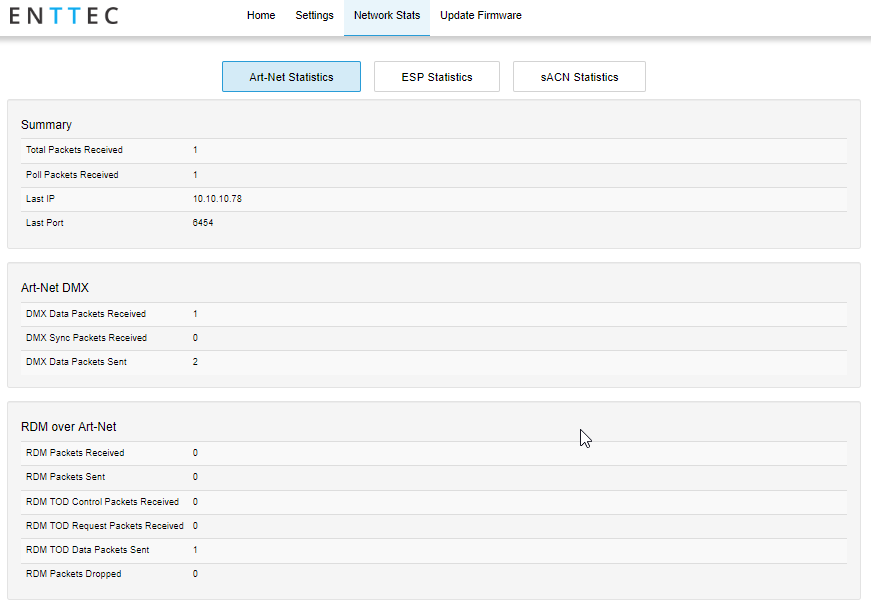
The Network Stats page is designed to provide an overview of the network data. This is broken down into Ethernet-DMX protocols statistics which can be located within the tabs. Art-Net statistics include a breakdown of Art-Net DMX packets sent and received, and RDM-over-Art-Net activity (packets sent / received, sub-device count, and TOD Control / Request packets).
Update Firmware tab
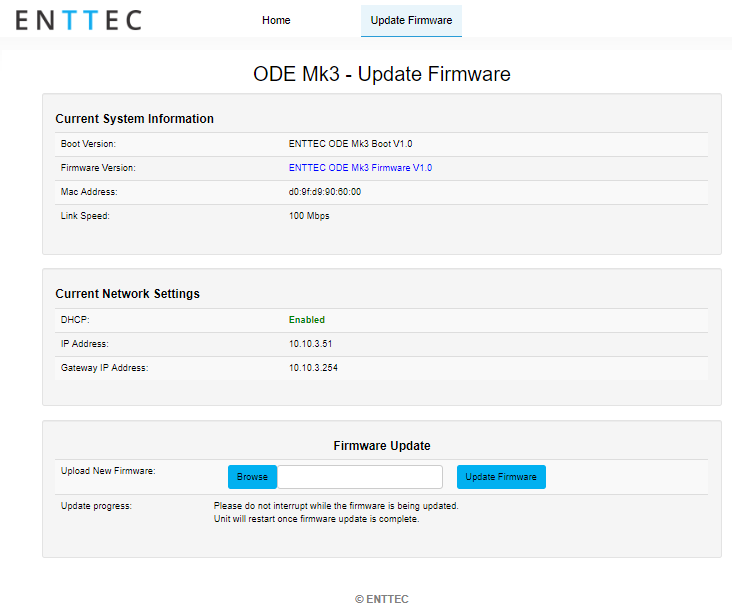
When selecting the Update Firmware tab, the ODE MK3 will stop outputting and the web interface boots into Update Firmware mode. It may take a while depending on the network setting and a brief error may show while the page reloads into boot mode — this is normal.
This will display basic information regarding the device including current Firmware Version, Mac Address and IP address information. The latest firmware can be downloaded from www.enttec.com.
- Download the latest firmware
.binfile from www.enttec.com. - Use the Browse button to select the file from your computer.
- Click Update Firmware to begin.
- After the update completes, the web interface reloads to the Home tab where you can verify the firmware version.
Reset to factory defaults
The ODE MK3 can be reset by either the web interface or the reset button on the device. It resumes the device's settings back to factory default.
Resetting via the web interface
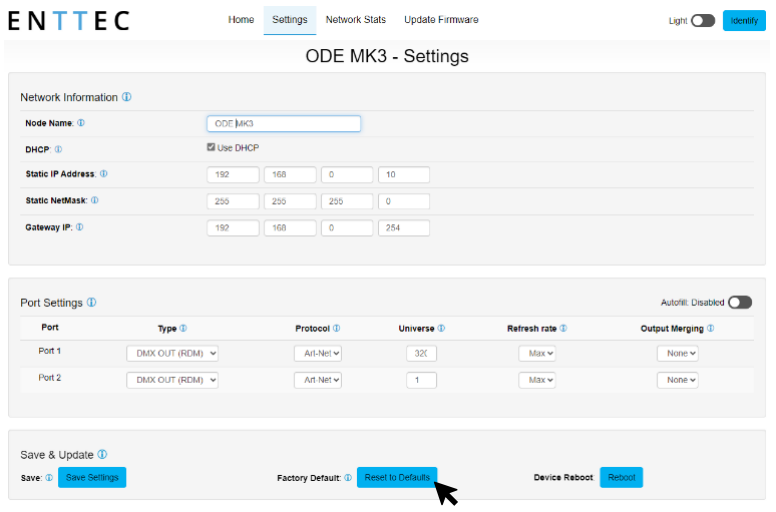
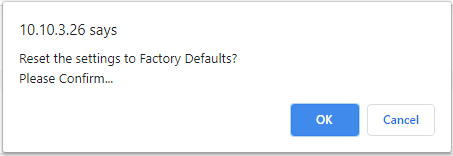
Navigate to the Reset to Defaults command located under the Settings tab in the ODE MK3's web interface. Upon selecting this command, a pop-up will appear, as illustrated below:
Resetting via the boot page
In certain scenarios you may require access to the boot mode for tasks such as firmware updates or performing a factory reset in case of unstable firmware. To access the boot, follow these steps:
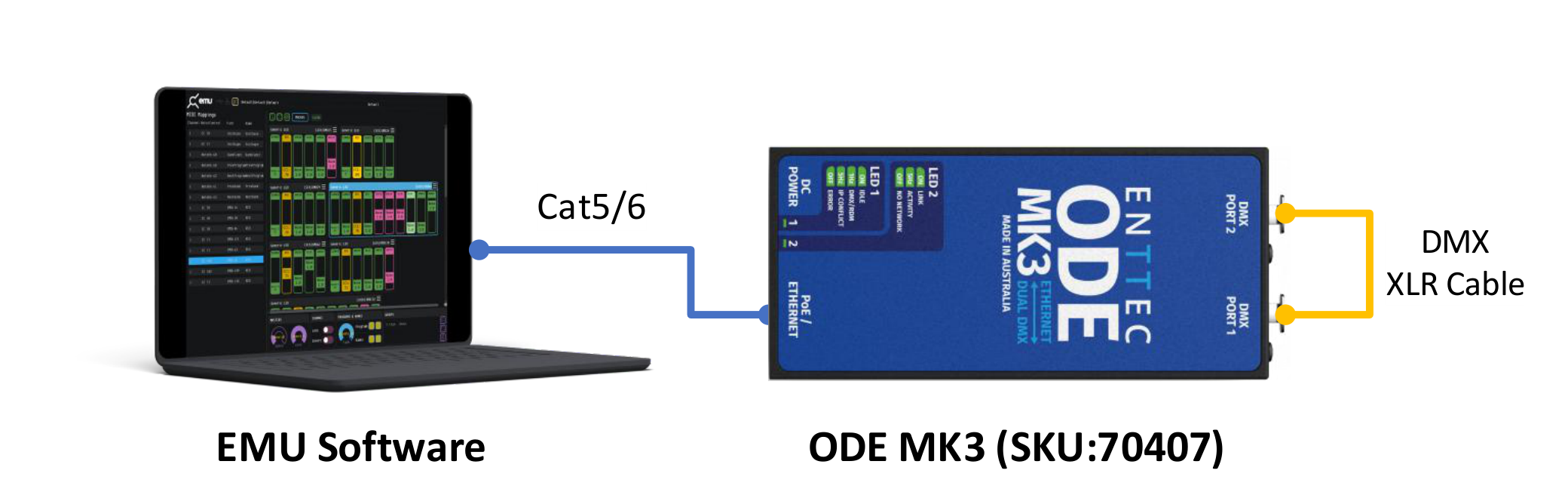
- Wire up DMX ports between Port 1 and Port 2.
- Connect the ODE MK3 to a computer via an Ethernet cable and both LED will flash at the same frequency indicating it is in boot.
- Launch the EMU Software on your computer and select the ODE MK3 discovered.
The EMU Software will prompt you to access the boot page for firmware updates or other maintenance tasks.
⚠️ Note: Resetting through the boot page feature is available from firmware V1.7 onward.
⚠️ Servicing, inspection & maintenance
- The device has no user-serviceable parts. If your installation has become damaged, parts should be replaced.
- ⚡ Power down the device and ensure a method is in place to stop the system from becoming energised during servicing, inspection & maintenance.
Key areas to examine during inspection:
- Ensure all connectors are mated securely and show no sign of damage or corrosion.
- Ensure all cabling has not obtained physical damage or been crushed.
- Check for dust or dirt build up on the device and schedule cleaning if necessary.
- Dirt or dust buildup can limit the ability for a device to dissipate heat and can lead to damage.
The replacement device should be installed in accordance with all steps within the installation guide. To order replacement devices or accessories contact your reseller or message ENTTEC directly.
Cleaning
Dust and dirt build up can limit the ability for the device to dissipate heat resulting in damage. It's important that the device is cleaned in a schedule fit for the environment it is installed within to ensure maximum product longevity.
Cleaning schedules will vary greatly depending on the operating environment. Generally, the more extreme the environment, the shorter the interval between cleaning.
⚠️ Before cleaning:
- Power down your system and ensure a method is in place to stop the system from becoming energised until cleaning is complete.
- Do not use abrasive, corrosive, or solvent-based cleaning products on a device.
- Do not spray device or accessories. The device is an IP20 product.
To clean an ENTTEC device, use low-pressure compressed air to remove dust, dirt and loose particles. If deemed necessary, wipe the device with a damp microfiber cloth.
A selection of environmental factors that may increase the need for frequent cleaning include:
- Use of stage fog, smoke or atmospheric devices.
- High airflow rates (i.e., in close proximity to air conditioning vents).
- High pollution levels or cigarette smoke.
- Airborne dust (from building work, the natural environment or pyrotechnic effects).
If any of these factors are present, inspect all elements of the system soon after installation to see whether cleaning is necessary, then check again at frequent intervals. This procedure will allow you to determine a reliable cleaning schedule for your installation.
Revision History
Please check your serial number and artwork on your device.
- Use the Serial Number to claim free license for EMU software unless there is a Promo Code sticker on the device. Promo Code is implemented after Serial Number 2367665 (August 2022).
Package contents
- ODE MK3
- Ethernet Cable
- Power supply with AU / EU / UK / US adapters
- EMU Promo Code — 6 months (Promo Code Sticker on the device)
Ordering information
For further support and to browse ENTTEC's range of products visit the ENTTEC website.
| Item | Part No. |
|---|---|
| ODE MK3 | 70407 |
⚠️ Note: Due to constant innovation, information within this document is subject to change.